Liner Notes for This Groove: This tanka was written in honor of a fellow student of Japanese tea ceremony. She recently got her tea name. What that means is that she has practiced tea for a long enough time at a high enough skill level that she earned a name that shows she is part of the Urasenke tea school lineage. My tea teacher told me that in older times tanka poetry was sometimes composed in honor of students who achieve a high level of proficiency. I decided to try my hand at it. She seemed quite pleasantly surprised at how well it turned out (she had no idea I wrote poetry at all).
I am years (and years) away from earning my tea name, but I do hope that if I do earn one, it will be as lovely a celebration as we had for her.
I did not have a bowl of tea under the cherry blossoms on my birthday month in the way I had hoped. This spring’s strangeness outlasted both my birthday and those blooms, going past the scent of summer honeysuckle, and likely to linger after the veins of the last red leaf of autumn are crusted with frost.
But the peace I find in my practice is also long lasting. Though the fall threatens more strange fruit and bitter harvests, though winter is a specter I can’t yet imagine, my battered mind finds a moment of respite in a space apart, created where the scent of matcha rises when water first meets it, and cradled in the sound of the whisk dancing in the bowl. And
even if I cannot pass a bowl of tea to another’s appreciative hand, that rest found
between the liminal spaces of foam and pouring water can travel freely for
miles, any time to anyone who sets aside a corner of their heart for tea.
I’ve learned to adapt, mixing matcha for one. But I can still share tea steeped in my heart, an ocean away, yet linked by spirit.
This was taken on the New Year's tea celebration my tea school holds every year.
Liner Notes for This Groove: This piece was created for the prompt given at Poets and Storytellers United's Weekly Scribblings #35, The Joy of Rest. It was also inspired by a request from my tea teacher. This September Urasenke North America is holding a chado relay, where they invite members from the different tea schools in North America to share images and words about their practice during these socially distanced times. I am a member of Urasenke Philadelphia and it will be our turn to share from the 7th to the 9th.
Koji looked at the assorted items he’d gathered and
hoped it was enough. He’d never attempted magic before. Pushing down the
feeling of panic that was threatening to burble out of his stomach and into his
throat, he shouted the words to finish the rite.
Koji blinked and looked around him. Where was the powerful kami the ritual should have summoned? He hung his head, about to limp away,
until he heard a tiny cough followed by a slurping noise. He looked
down. Sitting in front of him was a tiny yokai with a bird’s beak and three
fish tails drinking a bowl of tea. It gazed up at him with its large eyes. He
could not decide if it was more adorable or grotesque. Either way, he knew he
should still be polite.
“Hello,” he said.
“Hello,” she trilled. “Would you
care for some tea?”
“No, thank you. I’m sorry to have bothered you. I was hoping
to summon someone, er, bigger.”
She blinked at him again. “Why?”
Koji flushed and
looked away. “I had hoped they could train me. To be a strong warrior, like my
brother was.”
“I wouldn’t be much help there. Are you sure that’s what you
wanted?”
“Yes! He saved so many, like a hero in a story. I want to be
one too, even though—”
“Oh, I see now. I can help you.”
“You can teach me to fight?” Koji’s eyes widened.
“No,” she said. “I’ll help you save lives.”
“How?”
“I’ll give you knowledge.”
“How will that help?”
“Have you heard people wishing they could go back to such
and such time to do something that would have made a situation better? The
moment to act is now. I’ll tell you what actions to take. But they will be
simple, not the stuff of stories. You’ll get no praise or reward from anyplace
other than your heart. Will that do?”
Koji thought of his brother and nodded. She told him of a coming plague and how to
stay safe. When she finished, she gave him her tea bowl, which grew to fit his
hands.
“Share the knowledge as you would share tea,” she said
before disappearing.
"Thank you," he replied.
Liner Notes for This Groove: This short story was created for Poetry and Storytellers United's Weekly Scribblings #13: All the Small Things. It was inspired by an Atlas Obscura article about a healing spirit known as Amabie. You can also find out more about Amabie at Yokai.com After reading about her, I couldn't help by try my hand at drawing her too.
The oni considered the figure in white as she wobbled out of
the mists, heading for the sacred tree.
“That one has the look of ‘he’s done me wrong for the last
time’ on her face,” he said right before popping a glutinous rice ball the same
shade of white as her robes into his mouth. He chewed it slowly. “What do you
think, Fumihiro?”
“I think you had better share the mochi, Eiji,” Fumihiro
said. His red, clawed hand pulled out several of the sweet treats from the bowl
and gobbled them up.
Eiji did nothing to stop his elder brother from taking the
mochi. He was used to it. Eiji wrinkled his snout. “I think there are toenails
in that doll she’s carrying.”
Fumihiro sniffed the air. “Yes, that smells about right. She
must be very close to her target.”
“Of course she is. You have to be close to someone to hate
them this much,” Eiji said, looking at his brother. “And you truly have to hate
someone to risk being out during the hour of the ox to cast a
curse.”
The brothers watched
as the woman balanced on her single pronged sandals and hammered a nail through
the straw doll she brought with her, impaling it onto the sacred tree.
“Nice form,” Eiji said, nodding. “And she’s well prepared.
She not only has the dagger and the mirror, she’s managed to keep the trivet
with lit candles balanced on her head this whole time. There’s something to be
said for doing things properly.”
“I guess,” Fumihiro said. He looked away from the woman and
sucked on the ends of his matted hair, hoping to find any crumbs left from the
mochi there. Finding none, he moved on to investigate his loin cloth for other
traces of food.
Eiji leaned forward, tapping a claw on his red chin. He considered the woman, now screaming her desire to have her faithless lover’s heart devoured by jealousy. “There
is something to be said about bad form though.”
“And what’s that?”
“Itadekimasu,”* Eiji said, flashing his fangs in
the moonlight.
Liner Notes for this Groove:Oniare a legendary ogre-like creatures in Japanese mythology. The only thing they like better than sweet rice balls (mochi) is human flesh. The cursing ritual described in the story has a basis in Japanese mythology. The ushi no koku mairiis a notorious spell, requiring several components to do correctly. It must be performed between 1 and 3 a.m., called the Hour of the Ox. This is the time when the border between the world of the living and dead is thinnest, and it is also the time when evil spirits have the most power.
Liner Notes For This Groove: I remember when I first started
tea lessons. There were so many terms to learn, so many small details of
movement and positioning to keep straight. I may have responded in Spanish a
few times when I was supposed to answer in Japanese. I may have mangled my
Japanese so I told my guests to finish cleaning up for me. But the older more
experienced students were there to give me tips on how to remember things, tricks for polishing my techniques, and just be generally helpful.
So recently I had a lesson where I was the most senior
student. I did advance clean up to make the lessons flow more smoothly, just
the way I remember some of the older students did for me. I lent out some of my
tea things so the newer students could practice with them.
Now I’ve been studying long enough to know I’ve made decent
progress in my personal practice. But being able to help really made me feel
like I was part of the tea school in a way I hadn’t experienced before. I was
part of the process of helping others learn, and that felt really cool. Sen
Rikyu (the founder of the Urasenke Tea School) wrote many famous poems
regarding the art of tea. In his 98th poem he wrote, “Mastery in chanoyu
is a matter of empathy, versatility, and experience. When these three are
present and in balance, the person is capable of true understanding.” I make no claims to mastery but I’m happy
in knowing I’ve made enough advances in all three to feel a new sense of place
in a larger tradition.
Yummy tea treats. One of the new students was helpful
in finding the best angle to take the picture.
So dear Groovers, what traditions are close to your heart? Talk to me about them in the comments section and do drop a link to
your cyberhome if you want to take the conversation to a deeper place.
Art brewed in the blood
won't lose sharpness or flavor
at temperature's whim.
Liner Notes For this Groove: I take the majority of my tea lessons in one of the prettiest places I know, Shofuso (the Japanese house and gardens in Philadelphia's Fairmount Park). But this last weekend wasn't the best time to practice there. More than half of the USA was going through a scorcher of a heat wave. I wasn't sure if lessons were going to be cancelled outright, so I emailed my teachers to ask if the small utility room we sometimes used in the winter might be a better choice. They thought that was a good idea, so lessons were on.
Even with the venue change, I didn't expect too many people to make it. It was still a nasty day and the room's air conditioner could best be described as well-meaning. But it was a pretty full shed house, with a bunch of newer students (I was actually the most experienced one who showed). Even in a stuffy room, humid enough to make the tea clump and the tools stick to your hands a bit, we all enjoyed our lessons.
So dear Groovers, how was your weekend? Hopefully it was less melty than mine! Let's talk about it in the comments section. As always, feel free to drop a link to your cyber home if you'd like to continue the discussion there.
The shade of a blessed tree watches
over the seedlings that came from one righteous act. One of six thousand good
deeds seems so small against the six million lost in lightning and storms, in
the showers that choked. But to see the seedlings growing strong and true to their
roots, in this place where my grafted limbs have been trained to do justice to
the sublime green—this sends a fresh seed into my heart for me to treasure when
I am weary in the fight for the soil I’ve been planted in.
Liner
Notes for This Groove: I was so very honored to be part of a special
friendship tea ritualUrasenke
Philadelphia held in honor of the son of Chiune Sugihara (a
Japanese diplomat who saved 6,000+ Jews during WWII) and the son of one of the
people he saved, Rabbi Shimon Goldman. I’ve often had reason to agree with the quote “Where there is tea, there is hope” by Arthur Wing Pinero. But I felt especially
hopeful serving tea that afternoon.
This was the set up we used for the ceremony. I know it isn't very visible but the script on the tea container translates to "One Seed, Ten Thousand Seeds." Tea tools are chosen very carefully to suit the occasion. I think that this was the perfect tea container for that day.
This poem is linked to Imaginary Gardens with Real Toads' Tuesday Platform.
How's your week been dear Groovers? Anything making you feel a little hopeful? Catch me up with your world in the comments section. And feel free to work in a link in your comments if you want to take the discussion onto your cyberhome.
“Trash!” she shrieked, hurling another rotten fruit in Aiko’s
direction.
After a month of
this, you’d think her aim would have improved, even a little, Aiko thought
as she loosened the hold between the broken china and bent cutlery that made up
her body. The pieces of herself rearranged to fit between the gap between the
wall and the restaurant’s industrial freezer. They didn’t resume their normal
configuration until she got to her nest in the crawlspace in the wall.
Once inside Aiko examined the filleting knife that served as
her sword. Satisfied her weapon was as sharp as ever, she laid it down and
examined herself. She hadn’t lost too many chips this time, but the crack on
her breastplate had gotten bigger. Aiko could swap it out any time she liked,
but couldn’t bring herself to do it. It was a gift from the original owner of
the restaurant.
Aiko kept the restaurant free from pests, from hobgoblins to
roaches, for a decade. Of course she didn’t expect the new owner to salute her,
or even sit and share stories and sake with her. But to have her cracks and
dents earned through battle mocked! She didn’t have any other place to go, but
she refused to linger where she was disrespected.
She was contemplating which of her personal effects to take
with her, when she heard a rapping on the wall. Aiko picked up her
knife and went out. Tucked into the
space between the freezer and the wall was a paper cup with sake, and a note. “Dear
General, please stay.” It was signed by all of the kitchen staff.
Aiko folded the note as tightly as she could and tucked it
in the crack of her breastplate. She took the sake home, and placed the paper
cup in a place of honor among her things.
Seto-taisho by Matthew Meyer
Find more of his amazing art and fun facts about yokai
Process Note: Aiko is a type of of yokai (Japanese faery creature for lack of a better translation) known as a seto-taishoo, a little soldier made of broken kitchen things.
This short story was inspired by the prompt given at Imaginary Gardens With Real Toads: Mythical Prejudice, where we were asked to explore prejudice from the point of view of a mythical creature who is part of our modern world.
This poem was inspired by the prompt given at Imaginary Gardens With Real Toads, Creatures of the Night and the work of Yokai expert extraordinaire, Matt Meyer (if you love learning about Japanese creatures that go bump in the night, his website Yokai.com, as well as either of his books is a wonderful resource). I was fortunate enough to attend a Japanese Ghost Story lecture he gave at Shofuso, (the Japanese House at Philadelphia) earlier this evening. So when I got home and saw this prompt, I knew I'd have to write about one of the wonderfully eerie creatures he spoke about.
The ao andon is a creature intimately linked with traditional Japanese ghost story telling parties from the Edo period. The well-to-do would gather in a room with one hundred candle-lit lanterns. For every ghost story told, one candle would get extinguished. Once the last candle was put out, the ao andon would appear, and the gods only knew what terror she had planned for guests bold enough to go that far.
Lately I've been trying to wear full kimono to tea ceremony classes as a way to improve my technique. Some may joke, "How hard can that be? It's just wearing a robe, isn't it?" And I might even laugh back - through decidedly gritted teeth.
There's an art to kimono wearing, and it's a whole lot fussier than it might seem at first glance. A multitude of rules govern the proper wearing of one; there are schools that specialize in teaching people all the smallest details that take months, even years to complete. And if you're woman, the details of proper kimono wearing increase exponentially. Sometimes I look at the guys in my tea ceremony class, wishing I knew the Japanese version of "lucky bastards" so I could mutter it under my breath. They pretty much can stick to the same navy/gray/ brown color scheme year round while I'm scrambling to make sure the motifs in my kimono or it's style don't clash with the theme of the current time of year and coordinate with my obi.
I'm always a little surprised when people can't tell the difference between men's and women's kimono, though then again I've had more exposure to the culture than others have had. When I wrote my first Yuuki story around 10 years ago I played around with the idea of Westerners being somewhat clueless regarding this. I also thought the story was done as it was, until a certain Instigator insisted there was a bigger story in there. I mulled over her input and a.) realized the Instigator was right (stop cackling you!) and b.) while the other characters in the original story could plausibly be ignorant about the differences in kimono, as I expanded out the world it made no sense that no one else knew.
So I played around with his (yes his) back story a bit, researched some and discovered that while Yuuki generally identifies as male, he's fascinated with onagata of the Edo era, popular male actors skilled at impersonating females. To him, they are sort of kindred spirits, being able to change their appearance if not as easily as a kitsune might, still with a certain level of skill. This draws him to a more colorful and fem aesthetic. That tweaks things only a tiny bit from my original story (which I haven't published here or anywhere as of yet, and as the Instigator suggested might be more novella or even novel length rather than short story length - stop cackling already!) but I'm glad that I took the time to get to understand Yuuki better to give him the story he deserves. It also made me appreciate the prettiness of my kimono more, and I do feel pretty when I wear them. But I still feel exasperated when I have to fold them; there are rules for that too.
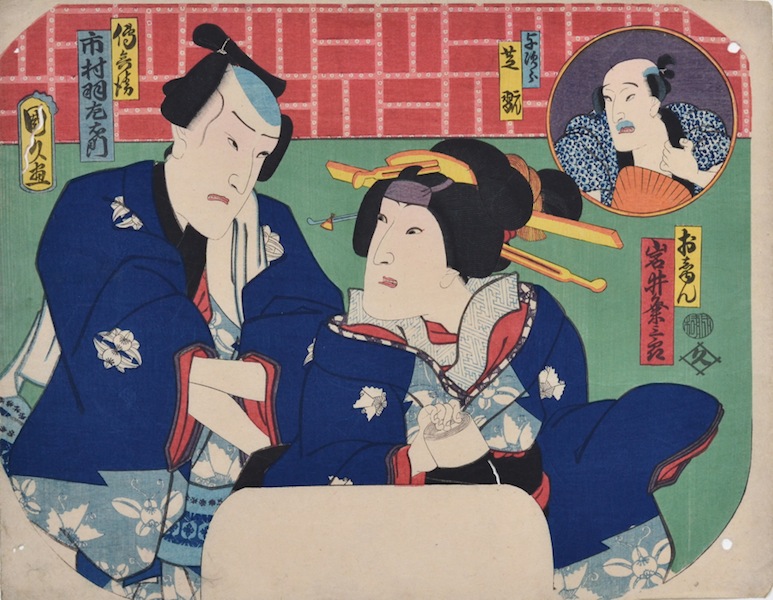
Fan Print #2 (Uchiwa-e) by Toyohara Kunichika (an onigata with a lover)
Yeah, so is anyone out there shocked Japan is mine? Didn't think so.
My intro to Japan started the way most Gen X-er's did. Anime. Though my first anime was not as well known in the US as the ones most people my age connected with, it's widely popular in Japan (I swear I'm not trying to be hipster about it - in fact if more US folks discovered this old school gem, I'd love it!). The main character's design is reminiscent of Snow White - if Snow had to dress as a boy and kick some ass sword fighting!
Princess Sapphire kicked royal butt back in the day when competent girl fighters were rare
One of the places I'd have to visit in Japan is the Osamu Tesuka animation museum, as he is the creator of Princess Knight (Japanese title: Ribon No Kishi) and is generally known as father of modern anime and manga, because so much of the style of anime derives directly from his work.
I also need to pay homage to a modern master of the art and visit the Ghibli Museum. For those not familiar, Hayao Miyazaki is a co-founder of Studio Ghibli and director of some of my all time favorite movies.
If you haven't seen Spirited Away, do it now!!!
Some time needs to be spent in Osaka. This city is known for it's culinary delights. A famous expression says that citizen of Kyoto will ruin themselves through extravagance in clothing while those from Osaka will ruin themselves though food.
I'm not a baseball fan, but I've adopted the Hanshin Tigers out of Osaka because of my desire to visit the city. Plus their fight song rocks.
I'd love to soak up some older culture and history of Japan as well, so Kyoto is a must. The tea school I belong to, Urasenke, is based out of Kyoto. Also I'd love to catch a performance of traditional Japanese performance arts there.
Speaking of Japanese arts, I want to visit sites sacred to Benzaiten, Goddess of the Arts and a Lady I have high regard for. There are several sites sacred to Her but the one I want to visit the most is in Enoshima, where one of Her most famous legends takes place (Her taming a dragon).
I was thrilled when I discovered this song about Benzaiten by Blackmoore's Night
This is the second of my postings for Magaly Guererro's All Hallows Grim 2013.
For all my little kits, both the ones I bore and the ones I didn't
And for Mike, who loved tails and tricks
"...He is a prankster, that one, cousin to Old Man Coyote.
He wears a hundred faces and knows a thousand tricks"
Sarah knew a measure of relief. "So I shouldn't take him too seriously?"
"That is more difficult to say. He is like a still pool in that he reflects your heart."
- from Moonheart, by Charles deLint
A Masked Soul's Wish
“Tell me a story!” Anna asked. “Tell me a fairy tale!”
Yuuki considered Anna for a moment. The
baby roundness of her face was steadily giving way to the features of a young
woman.
“Aren’t you a bit old for bedtime stories?
“No,” Anna said. “Besides, I asked for a fairy tale.
Everyone knows that real fairy tales are too dark for little kids anyway.”
Yuuki laughed. “True. Very well then…
Once, a very long time ago in a land far away, there was a
proud samurai, a veteran of several battles and honored by all his peers for his
nobility and valor.
If it were noted that he had survived some skirmishes while
some of his closest allies fell, people would speak of his cleverness and cool
head for battle. If some observed that he was very fortunate that a nice
portion of some of the wealth of his fallen allies found its way into his
hands, people would speak of how he also took in the families of some of his
comrades, even going so far as to marry one of the young widows to ensure she
would be looked after. If there were whispers of dark circles under his new
wife’s eyes or bruises on her arm, well those would be countered with
declarations of how fortunate she was to be the wife of such a distinguished
man and that the costly silks he kept her clothed in covered most of the
unsightly marks. And if busybodies, who had nothing better to do with their
time, spoke of how odd it was that he never seemed to keep the same servants
for very long and that a good many of them seemed to have vanished from the
earth once they left his employ, they were told that it may be better for their
health if they found other things to occupy their time.
Well, a reputation like the samurai had does attract some
base attention, and eventually it attracted the notice of the most infamous of
yokai, kitsune. Now I have seen the word yokai translated in your language as
demon, but personally I am not sure that is entirely accurate. I think a better
description might be found in the old storybooks you love so much Anna. Yokai
are fairly close to the idea of fairy creatures. Not the insipidly sweet sort
that flit about, only speaking in tinkling voices, but the sort that creep
about the darkest corners of the woods with voices filled with either honey or
brambles depending on their whim.
In any case, a skulk of kits began to frequent the samurai’s
estate, first drawn to it by the curious piles of bones and meat sometimes
tossed just beyond its borders. Later, it became a game for them to go into the
estate itself and boldly steal some of the samurai’s belongings. The samurai
eventually noticed and began to observe the creatures, finding out where their
den lay. One day, he hid behind a nearby cluster of rocks. When the kits ran
off to find some mischief, he left his hiding place and laid out some traps for
the little beasts. He had just finished setting up the last one when his
attention was caught by a faint shining inside the den. Using a nearby fallen
branch he managed to nudge and roll a pretty jewel to where he could just reach
it. The samurai admired it for several moments when suddenly he heard a loud
noise behind him. A very small kit had stumbled into one of his snares. Pleased
that he was successful so soon, the samurai started preparing a fire to burn
the creature in.
Terrified, the kit called out “Oniisan!” and at once a
slightly older kitsune appeared, caught partway between human and its true fox form, with its mask obscuring its features. The samurai smiled even more broadly, now
quite pleased with his good fortune, and addressed the kitsune.
“It seems I have two things that are of great interest to
you,” he said holding up the glowing jewel with one hand and indicating the kit
with the other.
“Please,” the kitsune said, “let my little brother go.”
“Oh, you ask for that before your hoshi no tama? Your little brother’s life over the
gem holding your soul? That is quite
noble for a yokai! It is always heartwarming to see those who value family
above themselves. I am a reasonable man; I will give you both back in exchange
for 3 promises. One promise for your brother, one promise for your hoshi no
tama and one for all the items your brothers and sisters have stolen from me.
Is that a deal?
The kitsune nodded.
The samurai’s smile grew as large as an oni’s. “Firstly, I
ask for you to follow my orders and be my protector. A man does not attain the
level of prestige that I have without leaving a few people unhappy. I want you
to protect me from assassination attempts or other such harm.”
“I will serve you and protect you so no enemy’s blade or fist harms you.”
“Second, I want you to always tell me the truth.”
“I will not lie to you.”
“Thirdly, you will serve not only me, but my family, for a
hundred generations.”
The kitsune hesitated a moment but when the samurai moved to throw the little
kit into the fire, the kitsune agreed to all the terms.
“Wonderful!” the samurai exclaimed. “The timing for this
could not be more auspicious. My daimyo will be visiting in a few weeks and I
need to have everything in readiness to meet him. I want you to prepare a
feast, something magnificent to raise me in my daimyo’s esteem.”
The kitsune look startled. “Sir, I am honored by your
estimation of my abilities, but I cannot conjure all of a feast from nothing.
The best I can do is create an illusion of a feast which will leave your daimyo
and his company famished.”
“Then what good are you?” the samurai fumed.
“Please sir, I can still be of help. I have some familiarity
with your daimyo’s tastes. Perhaps I can see what the abilities of your
servants are so I can suggest how to improve upon them where necessary.”
The samurai grumbled, but agreed this was a good idea.
First the kitsune sampled the meals prepared by the
samurai’s cooks.
“Not bad,” the kitsune said, sipping on a delicate broth.
“But is it good enough for my daimyo?” the samurai asked.
“Well, it will do…”
“That isn’t good enough. I want the best!”
“If it is the best you want,” the kitsune said, “I do know
of an exceedingly talented cook whose meals will be sure to please your daimyo
greatly.”
“Where can I find this cook?”
“Ah sir, that is the advantage of having a kitsune as a
servant. You do not need to go looking for this cook, I can use my skills to
enchant him and bring him here to you this very evening!”
“Wonderful!” The samurai declared.
“Very well sir. Now that we have the food taken care of,
what of the entertainment? Surely a feast of this caliber needs some talented
musicians to add another level of refinement.”
“Why yes, of course! We can hire some musicians from the
neighboring village.”
“Well,” the kitsune said hesitantly. “Are you sure they are
the proper caliber of musicians to perform for your daimyo’s retinue?”
The samurai was not sure. “Should I have them play for you to
see if they will be suitable?”
“There’s no need for that,” the kitsune replied. “I also
know of a group of musicians complete with a singer whose skills will impress
your daimyo. I can bring them here in much the same way as I can bring the cook
if you wish.”
“That is an excellent idea!”
That night the kitsune brought the samurai all the people he
had promised. The samurai sampled the cook’s food and listened to the
musicians’ and singer’s performance to make sure he was satisfied. As the
kitsune had said, all of them were exceptional. Still the samurai pushed them
hard to practice their skills until the appointed day, to make sure that their
best efforts would be given. He dealt with these new additions in much the same
manner as he had always run his household and if they were a few bruises
richer, at least their skill sets had improved during the time spent under the
samurai’s supervision.
The daimyo and his retinue arrived at the appointed day,
with the samurai’s household more lavishly decorated than anyone had ever seen
before, thanks to the kitsune’s skill with illusion. The daimyo however was
distracted, and in a somewhat sour mood, responding only as much as courtesy
demanded and hardly commenting on the loveliness of the samurai’s estate at all.
The samurai was not too concerned by it, certain that the feast he had planned
would raise not only his daimyo’s spirits, but his own rank in the daimyo’s
eyes.
At the feast that
evening, the samurai watched his lord to see if the meal agreed with him. From
the very first bite the daimyo smiled. The daimyo’s retinue noticed the change
in their lord and began praising the samurai for the exquisite meal.
One took a moment to whisper to him, “This is wonderful! I
have not seen him happy since his favorite servants disappeared.”
The complimentary chatter in hall ceased abruptly when the
musicians filed in. The daimyo’s eyes fell on the lovely young singer.
“What is the meaning of this?” he roared.
One of the daimyo’s men shouted, “What is our Lord’s
favorite concubine doing here?”
A terrible commotion followed right after, wherein tables
were upset, the singer fainted, the cook was dragged out of the kitchen and the
samurai was seized by the daimyo’s retainers and ordered to commit seppuku at
dawn the next day for the insult of kidnapping and mistreating the daimyo’s
favorite servants.
The kitsune visited the samurai that night.
“You!” The samurai shouted. “You lied to me. You said you
would protect me!”
“I never lied about anything. I knew all those servants
would be pleasing to the daimyo precisely because they were his favorites. Also
I have kept my word about no outside harm coming to you. No one has actually
struck you. You are merely being held until you commit seppuku tomorrow and
even that is harm you will be inflicting upon yourself. No enemy is
responsible. In fact all of this has come to pass because of your own greed and
pride. How am I to protect you from yourself?
But I am not without sympathy. Even now I can help you. If
you wish me to unlock this cell and let you escape I can.”
As the samurai rose to head towards the door, the kitsune
spoke again. “However, your daimyo still is staying at your estate and has your
entire household at his disposal. I wonder - what will he do if he finds you
gone? Will he ask another member of your household, your son for instance, to
take your place in committing seppuku to restore your family’s honor?”
The samurai glared at the kitsune, knowing full well that
would be the daimyo’s course of action if he escaped. “That is no choice then!”
He sat down again.
The kitsune turned, leaving the holding cell and said, “It
is always heartwarming to see those who value family above themselves.”
At dawn, the kitsune’s whole family turned out to witness
the samurai’s seppuku ritual. The kitsune had one last promise to keep before
passing over to serve the samurai’s son. When the kaishakunin,
the second in the seppuku ritual, went to cut the samurai’s head, he found that
he could not, no matter how hard he tried, so the samurai died slowly of the
cut he made himself in his own belly.”
Anna shuddered delightedly at the conclusion of the story.
“And what of the samurai’s son? What was he like?”
Yuuki replied, “He was not the man his father was, but he
could not be called pleasant to interact with either.”
“What of the third generation? The fourth? The fifth?”
“Much the same. Arrogant, rude, but not quite reaching the lofty
standards set by their ancestor.”
“And the hundredth generation?” Anna asked, her eyes wide.
Yuuki smiled tucking the sheets around the girl, “Ah that
one! She is as noisy as any kit, chattering when she should be sleeping. She is
a hard worker and has a far kinder heart than her ancestors. But her guardian
will nip her toes if she doesn’t go to sleep soon!”
Anna yawned. “Liar,” she said. “And it’s my choice to stay
up late listening to stories. You can’t save me from myself.”
Yuuki laughed, gave Anna a quick kiss on her forehead and
with a flick of red tail, slipped quietly out the window.
Its not quite yet 90 degrees on this sticky Philadelphia morning. A slight breeze relieves my skin every now and again, but its more of a tease. It comes and then goes quickly leaving me to the not so tender mercies of summer. I squirm slightly; I still lack the discipline to be able to sit seiza for a full ceremony, even a beginner one like the one we are practicing. Sighing, I focus on the anticipation of receiving the bowl of emerald goodness being prepared for me now.
My love affair with Japan has been going on for quite some time now. Like most Gen-Xers, I can probably trace the roots back to some piece of offbeat bit of animation that distinguished itself from everything else on American TV at the time. Battle of the Planets, Voltron, Star Blazers, Speed Racer, might be the most common titles you hear. My favorite was the genre defining Ribon No Kishi with it's daring sword-wielding and cross dressing princess. But of course, not every Gen-Xer takes it as far as I do.
O-shoban itashimasu (Thank you for letting me join you.) At some point, I got drawn in by Japan's legends and mythology. I got to appreciating it's ancient stories as well as it's modern ones. Had I been in college when this happened, I likely would have studied the Japanese language formally. But I satisfied myself by buying textbooks, flash cards and learning games to work with on my own. I became interested in Japan's native religion, Shintoism, reading all I could find about it. While that was great, it couldn't give me the full understanding I desired - I felt that would require a teacher (it's one of the reasons that though I like and admire what I've read on Shinto very much, I could not honestly consider myself a Shintoist). The Philadelphia area doesn't have any Shinto temples but it does have a vibrant Japanese cultural society. I had read that formal Japanese tea ceremony lessons were a good way to learn not just a small aspect of Japanese culture, but also that is was a good way to get a bit of insight into the philosophies and mindset that permeate Japan's religious thought. That attracted me. Well that, and the fact I really like tea. O-temae chodai
itashimasu (Thank you very much for preparing the tea.) It was a little daunting, learning all the motions at first. There seem to be so many of them, but after a while I came to understand that each of the movements has a purpose; the ceremony was designed to be as efficient as possible. It certainly doesn't feel that way at the start! Aside from the hand and arm motions, it takes quite a bit of getting used to sitting in the proper position and then rising gracefully, so as not to shower your fellow students in warm rinse water as you exit. Also, it's not always easy getting up extra early on a Saturday morning to drive an hour into the city. My mother, who has teasingly called me "Bruce Leroy" after the character in Berry Gordy's The Last Dragon, shakes her head at this latest passion of mine. (Hey mom, Bruce Leroy was technically all into Chinese culture, not Japanese 'kay?). Yes, it is weird getting up early, driving a good distance to consume a boiling hot beverage on days when even my dog would rather be inside. It isn't logical. But then again, what great passions in our lives really are? I almost think for it to really be a true passion, there must be just a touch of madness. Finally it is my turn to get my bowl. I turn it the way I have been instructed after saying the proper polite lines. The tea looks and smells perfect with it's bit of froth floating on top. I raise my bowl, and although this isn't officially part of the ceremony I always mentally say, itadekimasu (literally, I receive).
This posting is part of the fabulous Mad Tea Party 2013 blog party. Follow the link and take a peek at some of the other amazingly fun postings going on today